
“Help me to do it myself.”
This plea, which a small child once addressed to Maria Montessori, became the central creed of her pedagogy.
The task of adults is to let the child gain new knowledge and skills through their own efforts and at their own pace, and grow into the world around them.
“It is the human personality, not a method of education, that must be taken into account.”
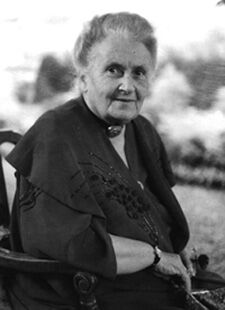
A doctor, scientist and educator who spent her whole life learning from children
An Italian educator, philosopher and scientist. In 1896 she graduated as the first woman in Italy to become a doctor of medicine. She worked at the university psychiatric clinic in Rome, where she focused on the education of children with intellectual disabilities, and later headed the department of anthropology at the University of Rome.
On 6 January 1907 she opened the Children's House (Casa dei Bambini) for poor children of pre-school age. It was here that she first used and went on to develop materials for sensorial education and materials for learning to read, write and count. In 1908 she gave up all her prestigious posts and began more than forty years of lecturing and writing. Her book on the method of scientific pedagogy has been translated into more than twenty languages.
Under fascism her schools in Italy were closed and her books were burned in Germany and Austria. From 1939 she lived in India, and she did not return to Europe for good until 1949.
Maria Montessori's work is not based on theory alone. Its strength lies in putting ideas into practice – most of her writings consist of interpretations of her observations of children and the reasoning behind her educational experiments.
The eight principles we build on
The child is the creator of themselves
Although the child develops in contact with the environment and is influenced by the people around them, only the child determines which stimuli will shape their actions, in what way and when.
Help me to do it myself
The task of adults is to let the child gain new knowledge and skills through their own efforts and at their own pace, and grow into the world around them.
The hand is the instrument of the mind
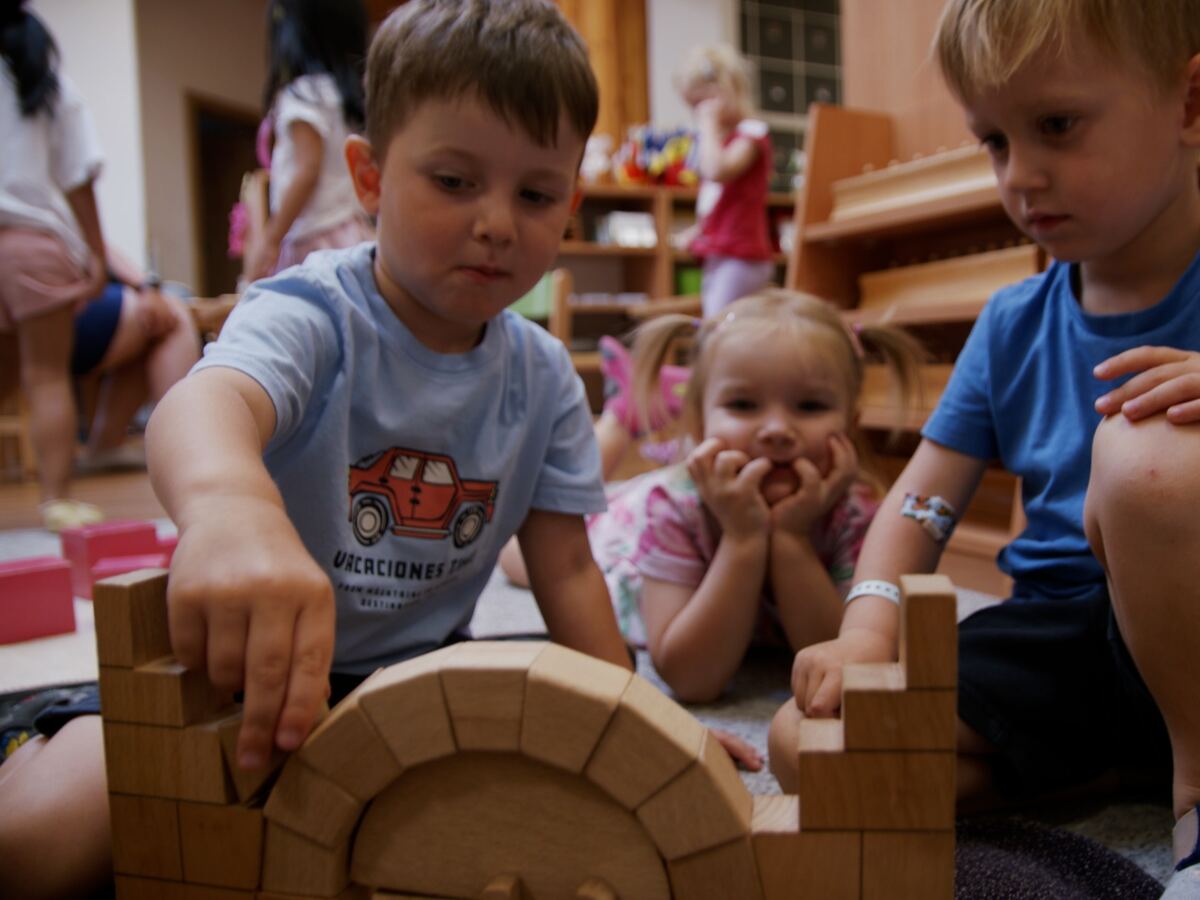
Working with the hands is the basis for understanding things and phenomena and for developing thought and speech. We start from concrete knowledge and handling real objects.
Sensitive periods
A time when the child is especially receptive and ready to acquire particular skills. If such a period is not used, the sensitivity fades away.
Free choice of work
The child decides what to do, who to work with and how long to work for.
Prepared environment
The workplace, materials and objects are arranged so that new knowledge can be acquired independently, without outside help.
Polarisation of attention
A child is able to concentrate intensely and for long periods on work that captures their interest. Polarisation of attention is the foundation of learning.
Holistic learning
The interplay of physical and mental activity must be reflected in the learning process too.
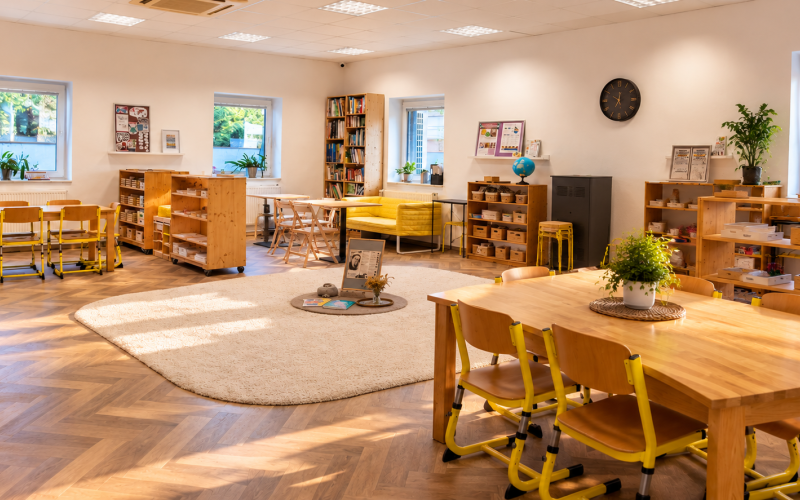
A classroom where everything is within a child's reach
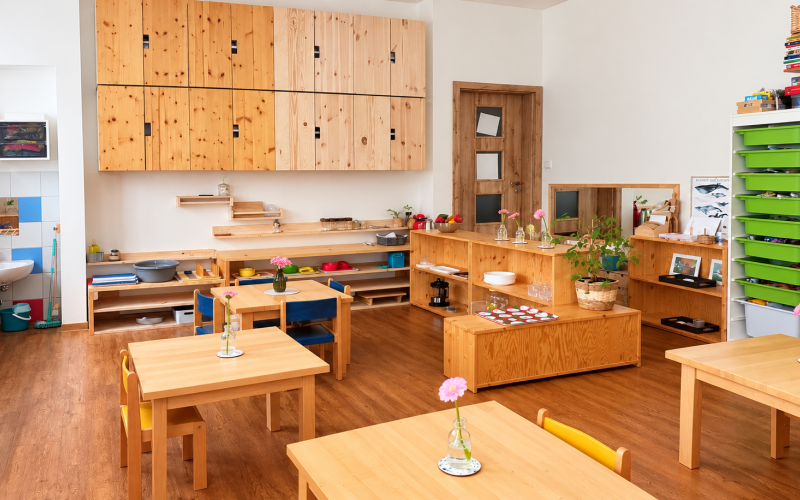
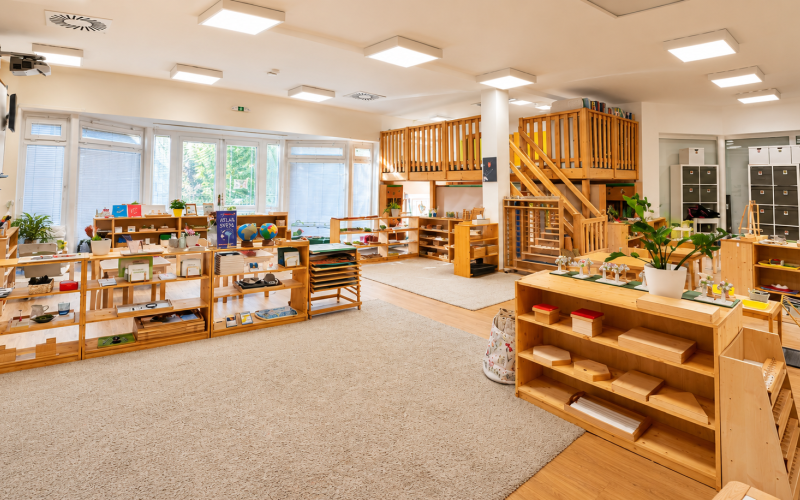
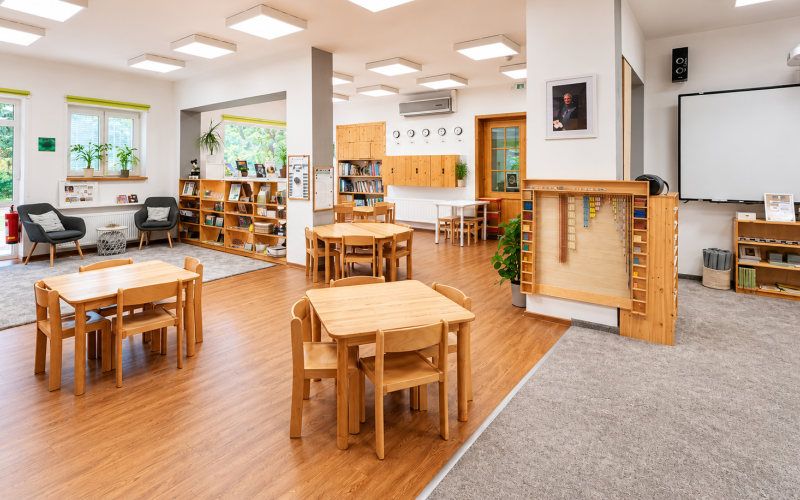
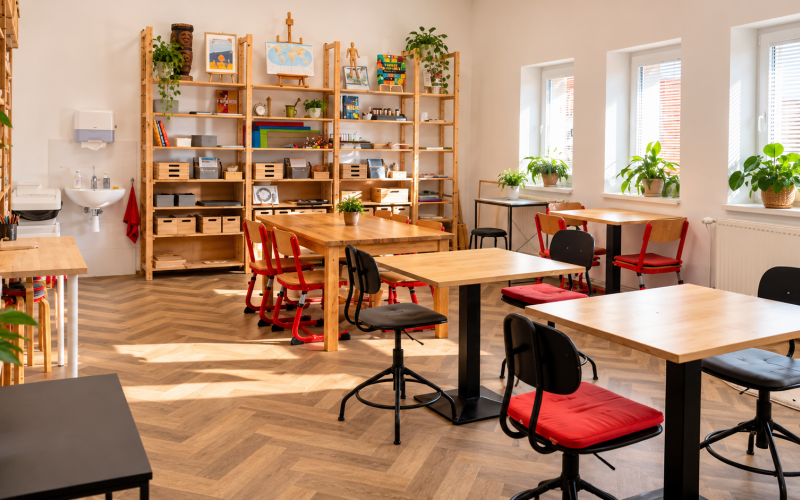
The kindergarten's Montessori classrooms form an environment scaled to the height of children aged 2.5 to 6. The shelves of activities are open, freely accessible and within reach. The primary school environment is arranged in the same way – separately for grades 1–3, 4–6 and 7–9.
The classroom is divided into areas that respond to the children's needs and sensitive phases of development.
“Education is not something the teacher does, but a natural process that unfolds spontaneously in every human being. Its essence lies not in listening to words but in practical experience. The teacher's task, then, is not to talk, but to think through and prepare a sequence of motivating elements that leads children to absorb knowledge spontaneously.”
Maria Montessori
Practical life
Materials for developing self-care, looking after oneself and one's surroundings. This also includes “good manners”, which arise spontaneously in the everyday interaction between children and adults. The classroom includes a fully equipped kitchen with worktops at the children's height.
Sensorial materials
Children practise distinguishing, comparing, sorting, naming and describing sensory impressions – length, width, temperature, weight, colour, position.
Language
Developed on three levels: the spoken word, writing and reading. We explore which sound belongs to which symbol, which naturally leads to building words and reading books.
Mathematics
Specially designed materials allow children to grasp the concepts of quantity, symbol, sequence and arithmetic operations – laying the foundations of mathematics.
Geography, science and the arts
Children learn about land and water forms, continents and countries and their flags. They learn to distinguish living and non-living nature and animal species. Art and music education play a significant role too.
The absorbent mind and sensitive periods
The first period of human development, in which the personality is formed, is the most important of all. The child's mind soaks up knowledge directly – a child learns their mother tongue simply by living. We adults take in information differently: we store it in our memory, where it remains separate from us, just as a vase remains separate from the water we have poured into it. The child, by contrast, undergoes a transformation.
Young children have abilities they will later lack. A fourteen-year-old boy will struggle to memorise vocabulary; a five-year-old does it easily and with joy. Children from birth to the age of six have gifts that we adults do not have – they create themselves.
Sensitive periods. A child does not learn through willpower but by being guided by an inner receptiveness. This receptiveness is present for a certain time set by nature – long enough for a new function to be learnt.
Unobtrusive guidance and tactful help
We always move from the concrete to the abstract, and specially developed materials are used for each area.
They make new phenomena easier to understand and help experiences and knowledge to be retained more deeply and for longer.
The twelve rules of the Montessori teacher
- 01The Montessori teacher creates the prepared environment and looks after it.
- 02The Montessori teacher has mastered the use of the teaching materials and can show the children how to use them.
- 03The Montessori teacher is active when helping the child make contact with the environment, and passive once that contact has been made.
- 04The Montessori teacher observes the children constantly, so as to be able to help the moment help is asked for.
- 05The Montessori teacher lends a helping hand only when asked for help.
- 06The Montessori teacher knows how to listen, and only then to ask.
- 07The Montessori teacher respects the child at work and does not interrupt them.
- 08The Montessori teacher respects the child when they make mistakes, without correcting them straight away.
- 09The Montessori teacher respects a child who is resting and watching others work, without disturbing them or forcing them to work.
- 10The Montessori teacher keeps trying to inspire the children to work.
- 11The Montessori teacher lets the children feel that they can rely on their help at any time, but never forces it on them.
- 12The Montessori teacher silently offers their soul to a child who has finished their work and spent their strength.
“The destiny of the future lies in the child. Whoever wishes for a successful society must protect the child and observe the natural way the child acts. Whoever wishes to follow my method needs to understand that they must not worship me, but follow the child as their teacher.” Maria Montessori
Come and see how Montessori works in practice
Four programmes from toddlers to grade 9, each with its own prepared environment and guides.